

Seat vehicles can be identified from the following numbers:
Location of Vehicle identification number– stamped on the vehicle– visible VIN behind the windscreen– on the type plateEngine Number– on the engine block . Production identification number– located inside the vehicleGearbox Number– on the gearbox . Radio and CD changer serial numbers– on the radio and CD changer
Table of Contents
Vehicle Identification Number:
Location of the VIN
Vehicles up to MY 1999


Toledo up to and including MY 2004
Exeo from MY 2009
Engine splash plate, in the middle

Right suspension strut dome

Engine splash plate, in the middle, behind a plastic window

Altea Freetrack from MY 2008
On the right wing

Toledo from MY 2005
Leon from MY 2006
Ibiza from MY 2009
On the inside of the wing, on the left, seen in the direction of travel
VIN Lettering


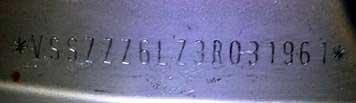



covered with protective film.
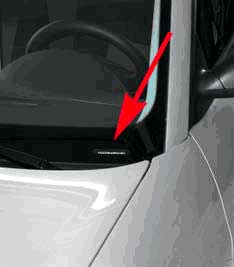
Visible-VIN
There is an additional VIN behind the windscreen near the left A-spar on all the more recent Seat vehicles.
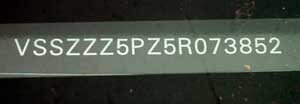
VIN breakdown
Factory Plate:
Possible factory plate locations
Vehicles up to MY 1999

Vehicles from MY 1999

Engine compartment bulkhead, on the right, in the direction of travel

Left suspension strut dome

Beneath the right-hand hinge on the bonnet
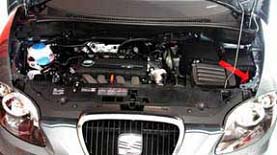
Altea Freetrack
Ibiza SC (Sportcoupe) from MY 2009
On the inside of the wing, on the left, seen in the direction of travel

On the inside of the wing, on the left, seen in the direction of travel

On the inside of the wing, on the left, seen in the direction of travel
Form of the factory plate
Metal type plate
In form and appearance the metal type plates correspond to the old- style VAG type plates

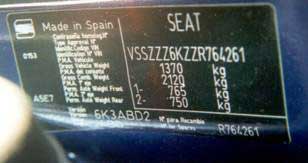
Vehicles from MY 1999
The types adhesive plate become lasered and the writing is noticeable by means of fingernail test.
Attention: with newer ones Types adhesive plates the writing is only badly noticeable (perhaps Tasteless
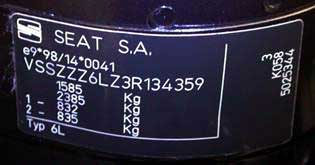
on the right side with PKN
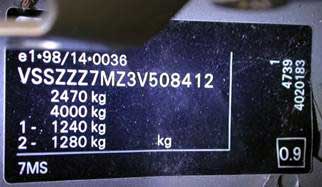
Just as on the VW Sharan, there is no PKN on the right, but, from the end of MY 2005 there is a PKN on the right!!!
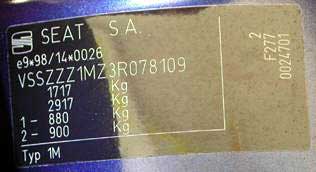
(no production identification number on the right!)
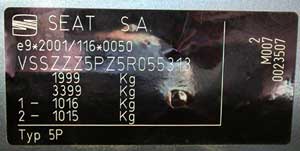
(no production identification number on the right!)
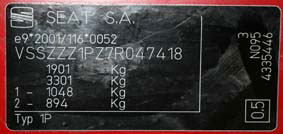
There may be a production identification number on the right, but it is not always present
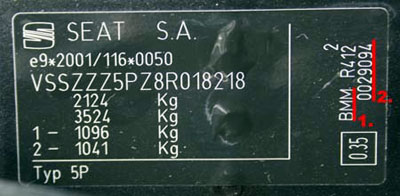
For example:
Altea from MY 2008
1. 3-character engine identification letters
2. No production identification number (this is repeated on the technical service sticker)
Or all models from 06/2007
For example:
Exeo from MY 2009

With a letter for the engine performance level, which is not, however, stamped onto the engine block (e.g.: CFM = the engine identification letters and the letter ‘A’ to indicate the engine performance level)
2. with the PKN
Production Identification Number – PKN:
The production identification number is an internal control number.
It can be found in various different places on a vehicle:
– the type plate sticker (only on the Arosa, Cordoba, Toledo (only until and including MY 2004), and the Alhambra from the end of MY 2005)
– on the technical service sticker (only on the Arosa, Cordoba, Toledo (only until and including MY 2004), and the Alhambra from the end of MY 2005, Leon ,Altea, Ibiza (however, with number 0 for weekday unknown)
– onn separate data carriers (from MY 2007: e. g. door disguising, roof skies, spare tires)
Breakdown of the Production Identification Number
The production identification number contains 7 characters broken down as follows:
e. g.: 25 3 3751
25 = Week of year
3 = Day of the week or 0
3751 = Serial number
Week of year:
The 1st and 2nd digits of the production identification number represent the week of the current year (not the week of the production year). The figures will normally range form 01 to 52.
Numbers higher than 52 are found on duplicate plates
Another difference is found in separately manufactured cars. In this case, the production identification number begins with 59
Day of the week
1 = Monday
2 = Tuesday
3= Wednesday
4= Thursday
5= Friday
6 = Saturday
0 = Exact production day not given
7 = Vehicle planned at a later stage
With Seat vehicles the number “0” is put down on the customer service sticker mostly as a day (the third place of the PKN) and often agrees at this point therefore not with the PKN on the types adhesive sign and an on-line query.
The year of construction cannot be deduced from the production identification number.
Engine Number:
Location of the engine number
Engines – photos
Petrol engines Diesel engines Replacement engines
Breakdown of the engine number
As a matter of course, SEAT vehicles are built using VW engines. In these vehicles, the engine number is also an 8 or 9-character code.
a) 2 letters / 6 numbers e.g.: PT021409
b) 1 number / 1 letter / 6 numbers e.g.: 1Z594703
c) 3 letters / 6 numbers e.g.: AFB109610
d) 3 letters / 1 letter / 5 numbers e.g.: ALHM42174
The engine number sometimes has an asterisk on both sides; sometimes none at the beginning, and sometimes none at all. There can also be spaces between individual blocks.
!!!!The engine numbers of new models have no asterisks and no spaces!!!!!
N.B.:
The engine number is normally stamped by needle, using an NC (numerically controlled) machine and the dot-matrix process. If the needle point breaks off, the unfinished number is ground out and the number stamped by hand.
According to the engine attribution list, the new engine identification letters have 4 characters (starting with CAGA). The last letter however merely stands for the performance level. This letter is not stamped onto the engine block.
(e.g., engine identification letters CAVE; what is actually stamped on = CAV 123456)
Newer engines also have a sticker with the corresponding engine number.

SEAT engines – Engine attribution lists
Sorted by engine identification letters:
Sorted by kW:
Gearbox number:
The gearbox numbers of current vehicles consist of 3 letters and the 5-digit date of construction.
Example: DTR28020
DTR = Transmission identification
28 = Day
02 = Month
0 = Year, e.g. 2000
VAG gearboxes – Gearbox attribution lists
Sorted by gearbox identification letters
2Y – DZL EAS – FZQ GDL – HXW JBH – MUF
Location of the gearbox number


Technical Service Label:
The technical service label is printed by computer and made of adhesive paper. It contains important information for the identification of the vehicle.
The technical service label is often removed when a car is customised. In most cases, however, bits of it are left sticking on the panel. If you soak these in solvent, they can be removed. Against a backlight, the VIN or other data can be read.
Location of the technical service label

The technical service sticker on the Alhambra: In the right-hand side compartment in the boot
What the technical service label looks like and the information it contains
Examples:

Except for the day of the week (0), the production identification number 48-0-5840 matches the online information, but not however the type plate. On this vehicle for example, the production identification number on the type plate is 0024701. This number is found on the top right of the technical service label and cannot be used for identification purposes.

The production identification number 07-5-5977 agrees with the type plate and the online information.

Toledo (from MY 2005)
With the exception of the day of the week (0), the production identification number matches the online information, but not the type plate.

Alhambra
Production identification number 35-3-5069 matches the online information, but not the type plate. Instead of the production identification number, the type plate always has the same number (4020183) as the VW Sharan.
Starting with the end of MY 2005, the production identification number (PKN) on the type plate matches the PKN on the technical service sticker and the online information.

With the exception of the day of the week (0), the production identification number matches the online information, but not the type plate.

Except for the day of the week (0), the production identification number matches the online information. The PKN on the type plate contains the correct number for the day.
There is no production identification number on the technical service label for the SEAT Ibiza until MY 2005.
Radio Number:
Broken down as on all VAG vehicles
Appearance and seat of the number see under VW Briefcase
| SE | Z | 1 | Z | 3 | W | 0123456 |
| 1 | 2 | 3 | 4 | 5 | 6 | 7 |
1=Producer of the vehicle
| SE | = | SEAT |
2=Filler
3=Producer of the radio
| 1 | = | Blaupunkt |
| 2 | = | Grundig |
| 3 | = | Sony |
| 4 | = | Delphi / Delco |
| 5 | = | Panasonic |
| 6 | = | Philips |
| 9 | = | Clarion |
4=Filler
5=Radio Type
| 1 | = | Alpha |
| 2 | = | Beta |
| 3 | = | Gamma |
| 4 | = | Mini Disk |
| 5 | = | Gamma in-built CD changer |
| 7 | = | Large-screen navigation apparatus |
| 8 | = | CD changer / Single |
Exception:
| 2 | = | Navigation apparatus with Beta radio |
| 7 | = | Premium |
| 8 | = | Sound 4000 |
6=Year of manufacture
The letters correspond to the model year letters on the VIN, but begin again with ‘’A’’ from 2001
| A | = | 2001 |
| B | = | 2002 |
| C | = | 2003 |
| D | = | 2004 |
| E | = | 2005 |
| F | = | 2006 |
| G | = | 2007 |
| H | = | 2008 |
| J | = | 2009 |
7=Serial number
Serial number given to the apparatus during production
Starting with the letter ‘’Y’’ (2000), the radio number can be checked in the VW works.
In the future there will no longer be an individual number on the apparatus (radio etc). It will be recorded in the apparatus itself and can be read off at a VW garage.

CD Changer Number:

