

Table of Contents
Jaguar

In General:
jaguar Until about 30 years ago Daimler produced its own models.
Example:

Since then the Daimler label has been used for particularly luxuriously fitted limousines (such as the Jaguar XL).
These vehicles can be distinguished by the typical Daimler radiator grille, Daimler boot opening handle and the “Daimler” badge at the back.
Since the beginning of 2009 these models have no longer been on sale and will not be so until further notice.
Jaguar/Daimler vehicles can be identified from the following numbers:
|
Model:


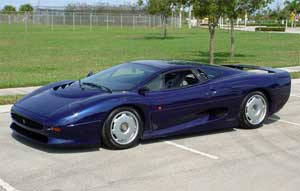

1. Vehicle Identification Number:
1.1 Location of the VIN
|

In the engine compartment, on the right inner wing

In the engine compartment on the overhanging part of the scuttle panel

On the crossmember behind the rear windscreen

Close-up view: In the engine compartment (at the back), on the right, on the crossmember behind the rear windscreen

In the boot, towards the side, on the right, under the carpet, near the rear wheel housing

(Another example, in this case the XK-8)

Behind the right back seat armrest in the right edge (back seat armrest by lever in the boot unlock, armrest prefold, carpet flap open)


Behind the right back seat armrest in the right edge (back seat armrest by lever in the boot unlock, armrest prefold, carpet flap open)

In the engine compartment, on the right suspension strut dome

In the engine compartment on the right strut tower,
the example shown here is an XJ (model year 2010)

see Item 1.1.1
1.1.1 Visible VIN
In addition to the stamped VIN, all newer models also have a “Visible VIN”.
On the XJ, the visible VIN was introduced in model year 1990, starting with VIN …594576.
Visible VINs are engraved onto an aluminium plate and can be seen beneath the windscreen on the driver’s side.
This is not a substitute for the VIN on the bodywork.
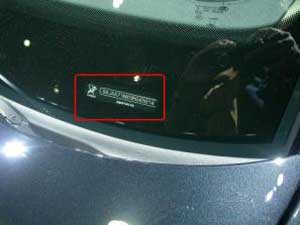
Examples of Visible VIN:


From the model XF the interior equipment-code is engraved, in addition, under the Visible VIN.

1.2 VIN Lettering
The FIN is stamped on (on newer models it is placed on by etching) in a straight. The VIN on all newer models always has an asterisk at both ends (exception: the XJ 220).
All characters in a VIN are the same size. From 2006 onwards, the VIN in the XK has been covered with transparent foil to protect it from corrosion.
Examples:


If at the works a mistake is made when applying a VIN, this is then crossed out legibly and the correct VIN is placed next to it.
1.3 Breakdown of the VIN
1.3.1 Breakdown of the VIN until MY 1999
1.3.2 Breakdown of the VIN from MY 2000
2. Type Plate:
2.1 Location of the type plate
The type plate is always placed on the left-hand A or B pillar.
It may however appear on the right-hand side on RHD vehicles.
On older vehicles the type plate was normally stuck or riveted onto the radiator yoke.
However, on the XJS Convertible the type plate was placed on the front left inner wing.


2.2 Form and appearance of the factory plate
Europe and ROW (except North America, the Gulf states, China and Argentina)
The type plate is a printed sticker, produced using a heat transfer process. The imprint can smear or even become separated from the base sticker if subjected to strong mechanical or chemical influences (inter alia, intensive washing or acetone)!
The words “Jaguar Cars Ltd” appear as an infinitely repeating sequence at an angle of 45°.
The letters are 2mm high an the distance between the lines is 4 mm.
The silver coloured base foil is destroyed if the type plate is removed.
Destroyed in this case means that the letters of the original infinitely repeating sequence printed on it (“VOID”) remain on the original carrier.
The infinitely repeating sequence “VOID” can also then be seen from the front on a type plate if an attempt is made to restick a type plate which has been removed.
Below is an example of a type plate which has been removed from its original carrier and on which the repeating sequence “VOID” can be seen (upside down in the image).

In addition to the normal information such as manufacturer, certification number, VIN and weights, the type code also has entries for the colour code (Paint – for further details see under point 8), fittings (Trim) and a two-letter date of manufacture code.
Examples:


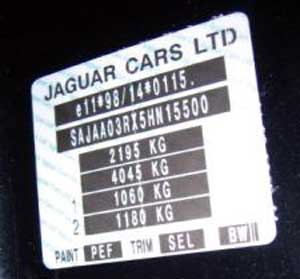


(older 3-Series type)

(older version)

2,2,1 Other type plates

| Point | Part-No. | Description |
| 1 | — | Maximum permissible axle load, front |
| 2 | — | Manufacturing date |
| 3 | — | Maximum weight |
| 4 | — | Maximum permissible axle load, rear |
| 5 | — | VIN |
| 6 | — | Design |
| 7 | — | Interior trim code |
| 8 | — | Colour code |

| Point | Part-No. | Description |
| 1 | — | Maximum permissible front axle load |
| 2 | — | Date of manufacture |
| 3 | — | Maximum weight |
| 4 | — | Maximum permissible rear axle load |
| 5 | — | VIN |
| 6 | — | Color code |
| 7 | — | Trim code |
| 8 | — | Type |

| Point | Part-No. | Description |
| 1 | — | Date of manufacture |
| 2 | — | VIN |
| 3 | — | Trim code |
| 4 | — | Color code |

| Point | Part-No. | Description |
| 1 | — | Number of passengers |
| 2 | — | Engine specification (type/displacement/performance) |
| 3 | — | VIN |
| 4 | — | Brand |
| 5 | — | Model |
| 6 | — | Maximum weight |
| 7 | — | Date of manufacture |
| 8 | — | Manufacturer’s name |

| Point | Part-No. | Description |
| 1 | — | Brand |
| 2 | — | Model |
| 3 | — | Maximum weight |
| 4 | — | Date of manufacture |
| 5 | — | Number of passengers |
| 6 | — | Engine specification |
| 7 | — | VIN |

|
|||||||||||||||||||||||||||||||
3. Engine Number:
It is not possible to identify a particular vehicle using the engine number, but, a VIN enquiry to the importer/dealer can result in the engine number of a particular vehicle being identified.
3.1 Location of the engine number

At the front, at the top, between the cylinder blocks
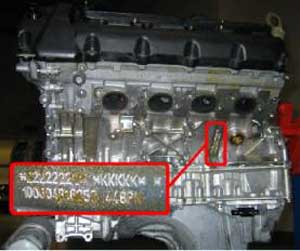
On the side, on the left of the engine block, beneath the third and fourth exhaust manifolds

on the bottom left approx. 15 cms before the oil filter at the side readable
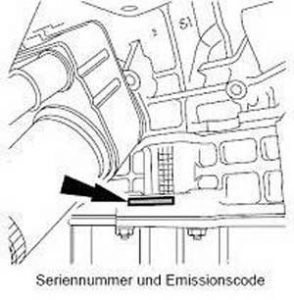
Near the oil filter, above the sump
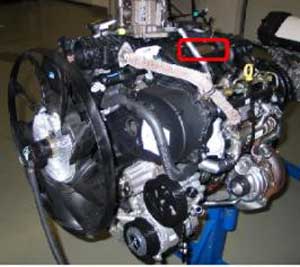
The engine identification number, serial number and emissions code are on a small metal plate on the top left on the engine cladding…
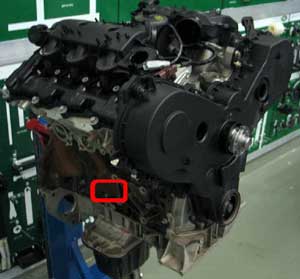
…and stamped onto the engine block on a smooth spot on the bottom right

Half way up on the front of the left-hand side

at the rear bottom of the left cylinder block next to the gearbox flange
3.2 Appearance of the engine number
The engine number is stamped or “needle punched” on the engine block, on a smoothly ground surface.
In addition a small, separate metal plate can also be screwed onto the engine (V6 Diesel engines).
The engine covering makes it difficult to read off the engine number.
Examples:





On newer engines there is also a sticker with the engine identification code and the Engine number:
Examples:


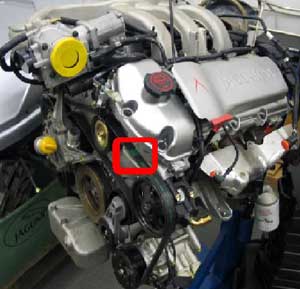


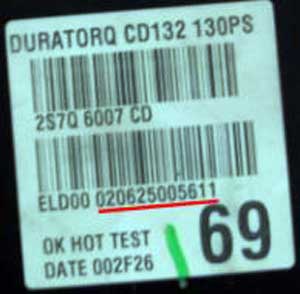

5,0 litre Gasoline (XJ, XF_MY 2010)


3.3 Breakdown of the engine number
|
||||||
| 1 = Date: 15. 15 May 2006 2 = Time: 09:53:24 |
The engine number on all V8 engines comprises the date and time of production.
The moment when the engine block arrives on the conveyor and the engine construction begins is taken as the time.
The date can either be in DDMMYY or YYMMDD format.
The time frequently contains seconds as well as hours and minutes.
Thus, for example, engine number 980904 0147 corresponds to the date of production 04.09.1998; at 01:47.
Some engine numbers have a suffix
Example: – 42 8 PS (4.2 litre 8-cylinder, PS = supercharged = Compressor)
– 44 8 PN (4,4 litre, 8-cylinder, PN = normal aspirated = induction engine)
Starting model year 2010, a 5-digit consecutive number has been used (instead of the time when construction was started), e.g.
|
1- Production date in YYMMDD format (090721 = 21 July 2009)
2- consecutive number
3- Engine capacity/displacement (50 = 5.0 litre / 42 = 4.2 litre)
4- Number of cylinders (8 = 8 cylinders)
5- Type of fuel (P = petrol)
6- Type of engine (N= naturally aspirated engine / S = supercharged [SC] compressor)
V6 petrol engines are made in the Cleveland engine plant.
The engine numbers for inline 4-cylinder engines have a different code.
They bwith a serial number and end with a code for the type of engine and transmission (Example: 401 stands for a 3.0 litre automatic and 402 stands for a 3.0 litre manual transmission engine).
4. Gearbox number:
It is not possible to identify a particular vehicle using the gearbox number, but, a VIN enquiry to the importer/dealer can result in the gearbox number of a particular vehicle being identified.
4.1 Location of the gearbox number
Jaguar uses gearboxes made by ZF (Zahnradfabrik Fredrichshafen) and Mercedes-Benz for its supercharged engines.
JATCO makes the automatic gearboxes on the X-Type and Getrag manufactures the manual gearboxes for the X-Type and the S-Type.
The gearbox number is either stamped onto the gearbox housing or else is on a metal plate or barcode plate on the gearbox housing.


4.2 Breakdown and appearance of the gearbox number
The appearance and breakdown of the gearbox numbers depends on the respective manufacturers, i.e
– Mercedes-Benz
– ZF
– JATCO
– Getrag
5. Radio Number:
Radio numbers cannot be used for tracing purposes.
However, a VIN enquiry to the Jaguar importer can result in the radio number of a particular vehicle being identified. Newer models have obstructed serially a multimedia device with screen.
Example XJ (Type 351) MY 2010

6. Colour Codes:
7. Vehicle Keys:
Jaguar keys do not have a locking code which can be read out, nor are they linked to a VIN.
Merely the 4-figure key code for him mechanical key it is grasped.
Current key (XK-R) in Keyless-Go format

